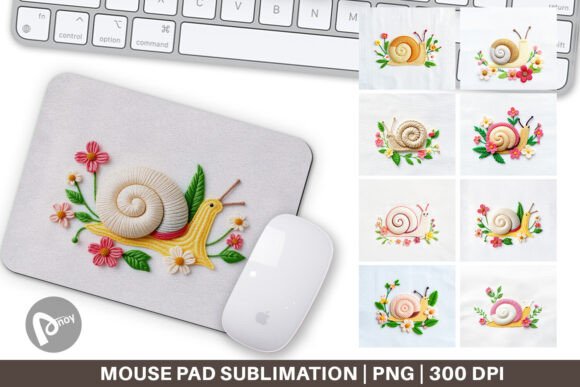
Mouse Pad Snail Embroidery
A Gentle, Whimsical Shape That Feels Like a Pause Button
The first thing that strikes me about Mouse Pad Snail Embroidery isn’t its cuteness—it’s its quiet confidence. This isn’t a frantic, hyper-detailed illustration screaming for attention. It’s a soft, rounded silhouette with gentle curves, subtle texture in the shell spiral, and just enough visual weight to hold its own on fabric without overwhelming it. As an embroidery designer who’s stitched hundreds of critter motifs, I immediately recognize this as a *breather* design: one that invites calm, not chaos. It feels like something you’d embroider onto a baby’s onesie for a nursery that leans into slow living—or stitch onto a linen tea towel for a boutique kitchen line that values handmade warmth over flash.
Where It Shines (and Where It Needs Thought)
I recently tested Mouse Pad Snail Embroidery on a medium-weight cotton twill tote bag—exactly the kind many Etsy sellers use for custom gift sets. On that surface, it stitched cleanly with minimal puckering. The snail’s smooth outline translated beautifully into satin stitch, and the shell’s inner spiral held definition without needing excessive fill stitch density. It looked polished, intentional, and quietly joyful—exactly what customers expect from a well-made handmade product.
It also worked well on a lightweight unisex sweatshirt, but only because I used tear-away stabilizer underneath and kept thread tension dialed in. On stretchy fabrics like jersey or thin knits? I’d hesitate. The design’s gentle curves can distort if the fabric shifts mid-stitch, especially around the tail and head. And on dark fabric, I made sure to test contrast first—some light gray or cream thread options didn’t read clearly without a white underlay, which adds bulk.
For baby embroidery or nursery decor, it’s a natural fit: soft, non-threatening, and full of quiet personality. But I wouldn’t place it near seams, curved edges like cap bills, or tight corners on pillow covers—those areas risk distortion or skipped stitches unless you’re using a very stable hoop size and precise placement.
What Real Customers Notice (Not Just What We Stitch)
Here’s what matters beyond technical execution: how people *respond*. When I showed a mockup of Mouse Pad Snail Embroidery on a linen apron to three small shop owners, all three said, “That feels like something my customer would *keep*.” Not just buy—but keep, wear, gift, and photograph. That’s rare. It’s not trendy; it’s timeless-adjacent. It supports brand consistency for makers who build around themes like mindfulness, nature, or gentle creativity—not loud branding or viral aesthetics.
As a personalized gift, it lands softly. A snail on a child’s backpack says “thoughtful,” not “cute overload.” On a holiday embroidered tea towel? It reads as cozy, not kitschy. And for craft fair shoppers scanning dozens of booths, it stands out by *not* shouting—its simplicity becomes its strongest visual asset.
Design Assets That Earn Their Place in Your Workflow
Mouse Pad Snail Embroidery belongs in your digital embroidery file library if you regularly create custom apparel, embroidered patches, or small-batch boutique products. Its strength lies in versatility—not complexity. It scales well from 3” to 5” without losing charm, and it adapts easily to different thread colors: sage green on oatmeal linen, navy on cream cotton, even mustard on charcoal denim.
But—and this is critical—it’s a Graphics file, not a pre-digitized machine embroidery design. That means you’ll need to digitize it yourself or hire a digitizer before stitching. If you're an Etsy seller offering personalized embroidery, confirm whether your digitizer can handle subtle gradients in the shell or whether simplifying the spiral improves stitch reliability. Don’t assume the PNG translates directly to clean satin stitch without review.
Practical Notes Before You Stitch
- Test first: Run it on scrap fabric matching your final project’s weight and stretch.
- Check thread color contrast: Especially on textured or dark fabrics—what looks clear on screen may vanish in stitch.
- Review stitch density: Too dense = stiff fabric; too sparse = gaps in the shell detail. Adjust based on fabric drape.
- Confirm hoop size and placement: The snail’s width fits comfortably in a 4x4 hoop, but allow breathing room—don’t crowd it near edges.
- Inspect small details: Zoom in on the eye and antenna tips. Will they hold up at your chosen size? If not, simplify before digitizing.
- Try black-and-white mockups: Helps assess value contrast and silhouette strength without color distraction.
- Use proper stabilizer: Medium-weight cut-away for knits, tear-away for stable wovens, and always test on layered garments.
- Verify licensing: Since this is listed under Illustrations, confirm whether commercial use of finished embroidered items—or resale of digitized versions—is permitted.
Final Thought: A Design That Supports, Not Dominates
Mouse Pad Snail Embroidery won’t win awards for technical fireworks—but it doesn’t need to. In real-world embroidery projects, the most successful designs are often the ones that serve the product, the person wearing it, and the story behind it. This snail does that. It’s a reliable, emotionally resonant choice for craft business owners who want their handmade product to feel considered, kind, and quietly confident. Whether you’re building an Etsy shop, stocking a local boutique, or gifting a custom piece to someone who needs a little slowness in their day—this is a design that earns its place, stitch by thoughtful stitch.